
visual
Qualitative Analysis
1 Integrated Daylighting Control
-
Orientation: The design team orientated the building to face south and elongated the east–west axis to increase the use of natural light.
-
Large exterior south-facing windows with wooden louvers and high ceilings are used to increase daylighting performance. The size and number of windows on south and east façade are larger than others. Clerestories on the second floor north façade were designed to optimize daylighting in the interior corridor.
-
Materials: Low-E and double windows with high performance allow light to enter while also provide thermal insulation.


Larger South-facing Windows from Inside View
Source: www.ArchitectureWeek.com
-
Interior design
The layout of functional spaces was also designed with the orientation to arrange natural daylight more appropriately, providing appropriate illuminance for working.
The open-plan office spaces facilitate daylighting and good bay views for occupants.
The workstation furniture with light color panels and walls with light colors can reflect more daylight to the interior workspaces.
But unfinished wood products with relatively dark colors, especially the ceiling, influence interior surfaces to have higher reflectivity and brighten the space, which need to be finished and allow for increased use of daylighting and less waste from the indirect fluorescents.
2 Electric Light Control
-
Zonal control
The first-floor office lighting is provided by indirect T-8 lamps with electronic ballasts. The first row of lights on the south side of the building near the windows is dimmable and controlled by photocells.
The second-floor office luminaires are 50% direct and 50% indirect. The first two rows of lamps on the south side are controlled by photocells.


T-8 Overhead Lighting and Task Lighting on the Second Floor (50%direct; 50%indirect)
Source: from NREL
T-8 Overhead Lighting on the First Floor (100% indirect)
Source: from NREL
Installed lighting power densities (LPDs) for the offices and conference lighting zones are at different lighting levels.

LPD by Zone
Source: from NREL
-
Task lighting is provided at all workstations.
-
Senor control
Daylight sensors and electric dimmers are used to control electric light when daylight levels are sufficient for work.
Each workstation has a motion sensor that shuts off computer monitor and task lighting.
Luminous sensors control overhead lighting.
The restroom lights are compact fluorescent lamps on occupancy sensors.
The lights in the normally occupied areas and the exterior lights are controlled by the building automation system and have manual/timed override switches. These controls are in parallel, such that if one is on, the lights are on.
-
Interior blinds on west, south and east facades are designed to control amount of glare.
3 View to outside
-
The larger size of the windows on the south façade contribute to have good view of the bay scenery.
-
By expressing the conference space as a separate structure, the consistency of the longer, primary mass is relieved, and the resulting t-shaped building creates a degree of enclosure for the deck while focusing views to the bay.
4 Comparison of LEED Buildings with CBE Survey Database for Lighting
According to the survey mentioned above, conducted by CBE, as for the overall satisfaction with lighting includes both daylight and electric light, the CBF building has one of the highest lighting ratings among the LEED buildings and is in the 95th percentile for the whole database.

Comparison of LEED Buildings with CBE Survey Database for Lighting
Source: Heerwagen, J. U. D. I. T. H., & Zagreus, L. (2005). The human factors of sustainable building design_ post occupancy evaluation of the Philip Merrill Environmental Center.
Quantitative Analysis
1 Daylighting measurements
-
Illuminance level of the second floor
The results of measurement conducted by NREL on Sep. 22, 2001, indicated that there is good daylight availability on the second floor and less on the first floor, supporting qualitative assessments of the Merrill Center.
Based on the typical target for lighting with 300–500 lux, results showed higher values everywhere except location 2, which indicates that enough natural light is available.

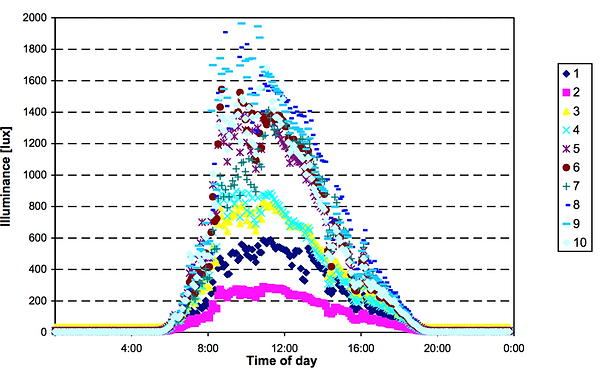
Locations for Automated Photometric Measurements on the Second Floor (September 22, 2001)
Source: from NREL
Sample for Automated Photometric Measurements on the Second Floor (September 22, 2001)
Source: from NREL
-
Additional measurements taken with handheld photometers at 5-minute intervals
Supplementary data were collected at locations spread around the entire second floor at a height of 3 ft. (1 m) at different times of the year. The results indicated that daylight penetrates across the second floor, but that glare problems can be expected, as shown by the high readings (greater than 2000 lux) and observations of occupants setting up makeshift shading devices.

Handheld Photometric Measurements on the Second Floor: June 30, 2001, 1300 (bright diffuse sky with electric lights off)

Handheld Photometric Measurements on the Second Floor: September 22, 2001, 1200 (mostly clear sky with electric lights off)

Handheld Photometric Measurements on the Second Floor: January 2, 2002, 0900 (clear sky with electric lights off)

Source: www.ArchitectureWeek.com
2 Lighting measurements
-
Energy use and saving for electric lighting
The average weekday lighting energy use for the lights (except task lighting) on the second floor of the main building for January and June 2002 have been measured. The shorter days in January mean that in the evening, less light is available and more electric lights are in use. The data indicated that because of daylighting, the average reductions in electric lighting on the second floor of the main building are roughly 20%.
The difference is seen from January through June between 5:00 p.m. and 6:00 p.m. The early morning peak is related to the cleaning crew.

Sample for Automated Photometric Measurements on the Second Floor (September 22, 2001)
Source: from NREL
Average Weekday Profile of Energy Use for Second Floor Lighting in January and June
Source: from NREL
Qualitative
-
Integrated daylighting control
-
Electric light control
-
View to outside
-
Lighting
Quantitative
-
Daylighting measurements
-
Lighting measurements