
Natural Ventilation allows the building to be passively cooled for about one third of the year reducing the building’s dependence on mechanical cooling and energy use.

Natural Ventilation Principles of Philip Merrill Environmental Center
Source: Smithgroup

Intended airflow path at design phase
Source: Smithgroup
-
Air flows enter the building from southern side
-
Offering enough fresh air to offices
-
Removing odour in the toilet
2 Ventilation System
-
Mixed-Mode Natural Ventilation System
Indoor/outdoor temperature and humidity sensors notify occupants when conditions are optimal for natural ventilation; employees manually open windows and the mechanical system turns off.
-
A demand controlled ventilation system
It will save energy by utilizing CO2 sensors to control the amount of outside air introduced to the building based on building occupancy, optimizing indoor air quality. The north, motorized windows also have moisture sensors that detect when it is raining so that the windows can be automatically closed.
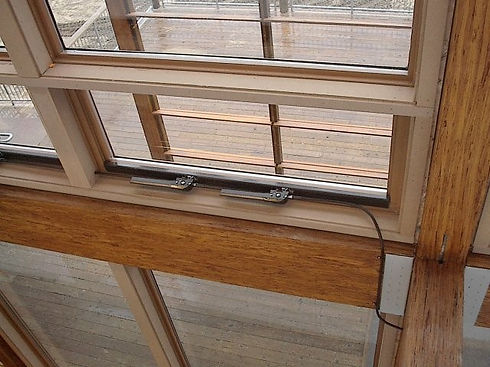

Signage directs occupants to operate windows
Source: Deru M, Torcellini P, Ellis P. Analysis of the Energy Performance of the Chesapeake Bay Foundation's Philip Merrill Environmental Center[M]. National Renewable Energy Laboratory, 2005.
Moisture sensors detect rain and close windows automatically
Source: Deru M, Torcellini P, Ellis P. Analysis of the Energy Performance of the Chesapeake Bay Foundation's Philip Merrill Environmental Center[M]. National Renewable Energy Laboratory, 2005.
Quantitative Analysis

-
The natural ventilation system is a hybrid or mixed-mode system in that fans are often used to help move ventilation air.
-
These fans exhaust air on the north side.
-
This ventilation system providing an estimated supplementary air change rate 1.025 air changes per hour.
-
Inlet windows total approximately 495 ft2, while outlets total approximately 822 ft2.
Source: Deru M, Torcellini P, Ellis P. Analysis of the Energy Performance of the Chesapeake Bay Foundation's Philip Merrill Environmental Center[M]. National Renewable Energy Laboratory, 2005.

When meeting some specific conditions, fans can be turned on, and occupants open windows until air between 7.7 and 22.1 C. By using this system can help to avoid wasting energy.
Source: Deru M, Torcellini P, Ellis P. Analysis of the Energy Performance of the Chesapeake Bay Foundation's Philip Merrill Environmental Center[M]. National Renewable Energy Laboratory, 2005.
Air indoor quality (IAQ)
Qualitative Analysis
Qualitative
-
Natural Ventilation
-
Ventilation System
-
Air Quality Satisfaction
Quantitative
-
Fan Ventilation Rate
-
Ventilation temperature Condition
1 Natural Ventilation
1 Fan Ventilation Rate
2 Ventilation Temperature Condition

The CBF building score in this category is again rated higher than other LEED buildings, and has also achieved the second highest rating for air quality in the whole CBE building database.
Comparison of LEED Buildings with CBE Survey Database for Indoor Air Quality Source: Heerwagen, J. U. D. I. T. H., & Zagreus, L. (2005). The human factors of sustainable building design_ post occupancy evaluation of the Philip Merrill Environmental Center.