
Qualitative Analysis
1 Site Surroundings
-
The Philip Merrill Environmental Center is located on the southeast of Annapolis, MD, situated on the western shore of Chesapeake Bay. The site is restored to the representative ecosystems found within the Bay’s watershed including woodlands, wetlands, and even an oyster reef, which is mainly surrounded by undeveloped fields.
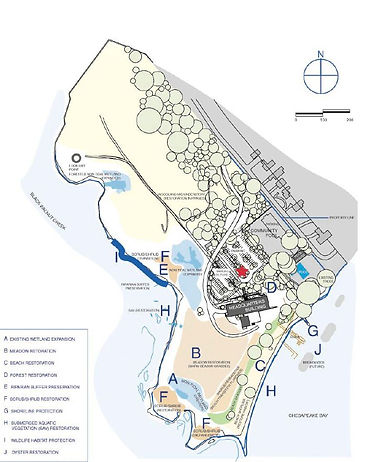

Location and layout
Source: Google Map
Site Plan
Source: www.smithgroupjjr.com
2 Plan of Functional Space
-
With various functions, mainly including commercial office, entertainment and cultural center, the spatial characteristic displays openness and comprehensiveness (integrity).
-
The overall depth of the building is approximately 80 feet. There are two floors. The second floor features a double-height ceiling.
-
The form of the building is composed of two shed-roof structures oriented to the South. One shed is long and narrow, presenting its broad face to the bay, and houses the reception area, offices, and support functions. Another shed structure is pulled away from the south bay-side, equal in height, but much smaller with an entirely square footprint. It serves as the conference space, with an attached staff lunchroom and kitchen. The two structures sit gracefully on slender pilings hovering above the landscape, and are connected by a large deck.
-
Located at grade level under the first floor are a storage area, mechanical rooms, and an open air parking area, which prevents polluted runoff from entering the bay.
-
The building interior space is organized into four quadrants, two on each floor, each separated by the central lobby and exhibit space. Each quadrant accommodates a different department whose layout of open workstations is unique to that department.
-
Open workstations allow every employee to enjoy views of the bay, as well as enabling sustainable strategies such as daylighting and natural ventilation. Meeting rooms and other shared spaces within each department provide opportunities for private dialogues.

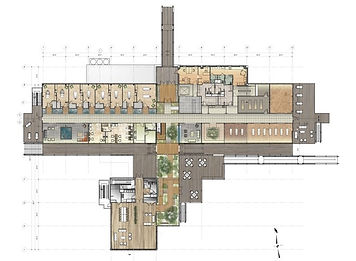
The First Floor Plan
Source: Smith group designed. www.coroflot.com
The Second Floor Plan
Source: Smith group designed. www.coroflot.com

The N-S Section Plan
Source: Smith group designed. www.ArchitectureWeek.com
3 Interior facilities
-
As a mixed-functional center, the shared facilities are taken into consideration, including conference room, meeting rooms, lunchroom, car park, rest spaces, etc.
-
The vertical integration within the center including lifts, escalators, stairs and corridors sufficiently guarantee the efficiency and effectiveness of internal circulation, as well as improving the performance of accessibility to each department and shared facilities.
-
Open workstations and integrated vertical system help occupants easily find way in the building.
-
Considering the provision for disabled, barrier free ramps at the north entrance and the south façade, the barrier free lift and accessible toilets are adequately provided to improve the convenience of the handicapped.
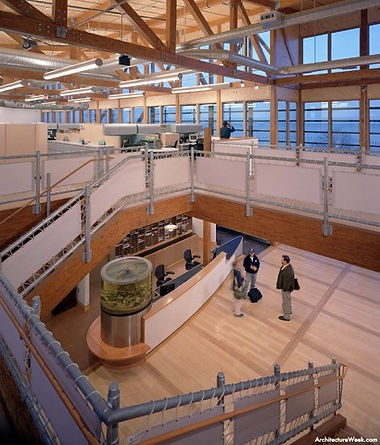


View of the Entrance Lobby
Source: Taken by Prakash Patel
View of Barrier Free Ramps at the North Entrance and the South Façade
Source: http-//inhabitat.com/chesapeake-bay-foundation-headquarters-greenest-building-ever/cbf-merrill-environmental-center-2/
4 External Space
-
From meetings to weddings, the center offers a waterfront setting for various social activities, including some shared internal areas and open space. Outdoor area around the site is used for interactive lessons that link the people and built environment with nature.
-
The outdoor space was mainly designed around the restoration of the natural landscape. To minimize site disruptions, the parking lot on the north of the building, were sited over the footprint of the former pool house.

5 Comparison of LEED Buildings with CBE Survey Database for Overall Workspace Satisfaction
-
The Center for the Built Environment (CBE) at the University of California, Berkeley, has surveyed approximately 170 buildings to date (represented by small blue dots), of which ten have a LEED rating (identified by large red circles). The overall workspace satisfaction for the CBF building is much higher than for any of the other LEED buildings, and it is the third highest in the entire database.

Quantitative Analysis
-
Indoor spaces: office (65%), conference (10%), dining (2%), restrooms (3%), circulation (4%), electrical systems (3%), lobby/reception (4%), mechanical systems (9%).
-
Outdoor spaces: wildlife habitat (40%), restored landscape (48%), parking (5%), drives/roadway (2%), patio/hardscape (1%), interpretive landscape (2%), pedestrian/non-motorized vehicle path (2%).


Various Social Activities Conducted in the Open Space
Source: www.smithgroupjjr.com
Comparison of LEED Buildings with CBE Survey Database for Overall Workplace Satisfaction
Source: Heerwagen, J. U. D. I. T. H., & Zagreus, L. (2005). The human factors of sustainable building design_ post occupancy evaluation of the Philip Merrill Environmental Center.
View of the Open Workstations
Source: http-//inhabitat.com/chesapeake-bay-foundation-headquarters-greenest-building-ever/cbf-merrill-environmental-center-2/
Building Programs
Souce: Statistics Source: U.S. Department of Energy
1 Space Usage
2 Occupancy Density
-
Typically occupied by 80 People, 40 hours per week (Statistics Source: U.S. Department of Energy)
Qualitative
-
Site surroundings
-
Plan of functional space
-
Interior facilities
-
External space
-
Overall Workspace Satisfaction
Quantitative
-
Space usage
-
Occupancy density